

Exiting the Capitalist Mixer
On ego loss, invisible labor, and finding self-worth beyond the capitalist markers of success

Age old question: Who am I?
This week we are diving into what it means to find self worth beyond the guise of capitalism — through the lens of becoming a parent.
It might seem like a jump going from tech and AI topics to parenthood, but when Philip and I first started Still Human this is exactly the kind of thing we wanted to weave into our writing. AI is a factor of our lives that will irrevocably impact our human experience, but we are in fact still human. And our human experiences matter more than ever.
Human Wisdom
Finding self-worth beyond the traditional markers of success is something I’ve been working on my entire adult life. It only more recently came to a head after becoming a parent.
Hopefully this goes without saying, but while I talk about motherhood in this article, this realization of self worth can apply to any massive shift in your life.
You can have similar realizations when backpacking through Southeast Asia, losing your job, moving to a new city, or doing just a little too much (but maybe the perfect amount) of psilocybin in the woods.
Anytime we are zapped out of our comfort zone and experience some sort of ego loss, we experience an unraveling. We are forced to investigate different versions of ourselves we had not yet unearthed. The process is not always pleasant, but the result is a deeper connection to our true selves. It is one step closer to pure and divine self-expression — something I believe we all cave so deeply as humans.
The day Chat GPT made me cry:
On a day like any other, ChatGPT made me cry. I am not particularly proud of this. I am not overjoyed that the mystic realization that hit me so deeply came from a robot — but alas it did.
When ChatGPT rolled out their Spotify-like wrapped feature, I was excited to dive in. I thought it might give me insights into my post-baby career journey, or what new business venture I could pursue. Maybe it would give me a flashy superlative like most likely to “be the best at everything”. But no. It gave me the mirror I needed.
“Most likely to turn motherhood into a Masterclass”
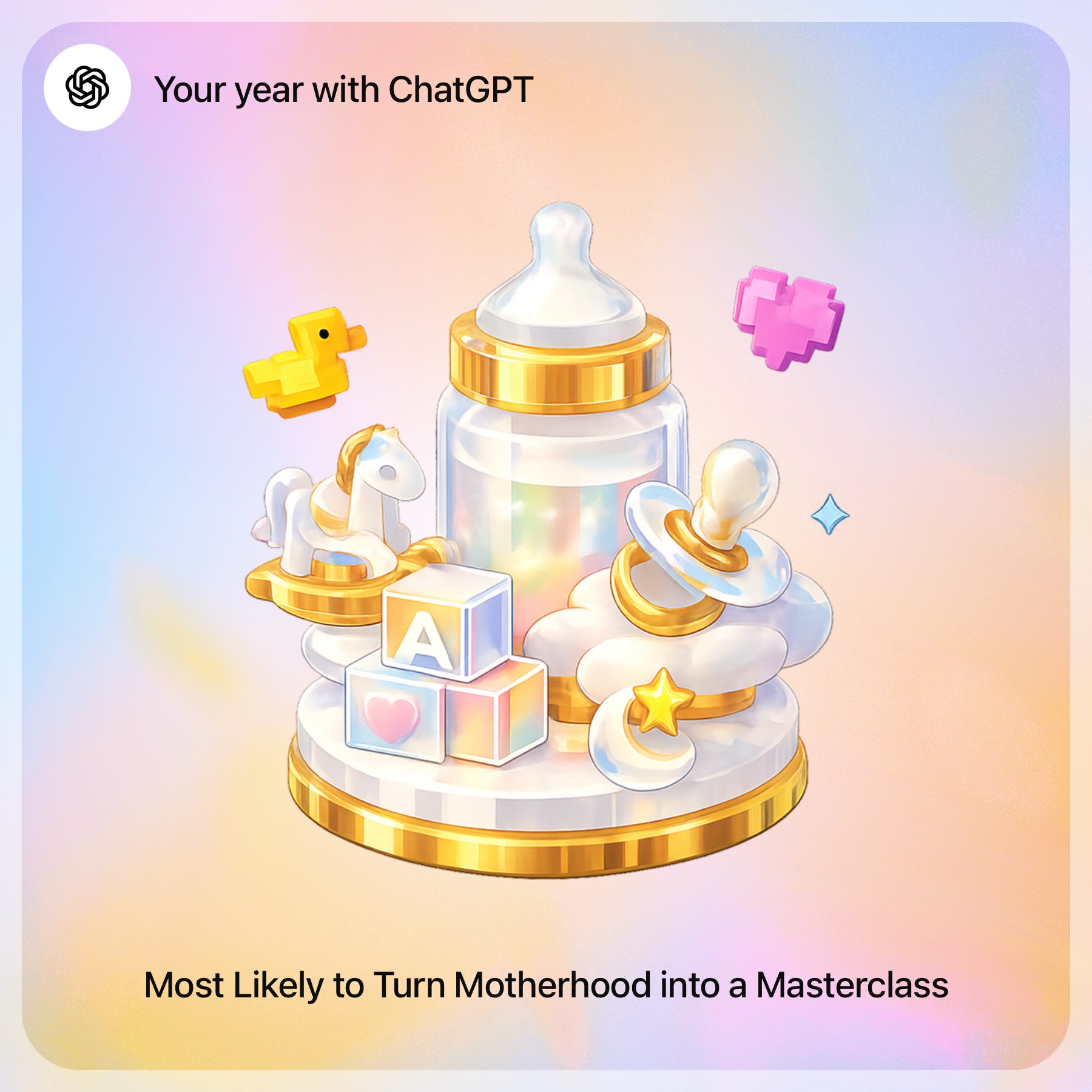
Seeing this was like wiping the fog from a cloudy mirror. I finally saw myself. Baggy eyes and a creaky back, but filled with newfound wisdom.
At that moment I cried. I cried because I realized how much I had grown in the last year. Not as a business owner. Not how much my bank account grew. Not how much I expanded my network or how many followers I amassed — none of that.
I cried because I realized how much I grew as a mother. How much late night research I had done, how much patience I had gained, how many physical challenges I had overcome, and deep love I had given and experienced.
It took me a full year to wipe off the foggy mirror and give myself any sort of credit. The kind of credit I would quickly give myself after launching a simple app feature. But it took me a whole year to give myself any credit for becoming a mother.
Mostly because motherhood and the act of mothering is not tied to a dollar amount — all of the walks to the park, working on speech, crawling, the endless research on sleep, development, and eating — The breastfeeding struggles, the intense c-section recovery — all of it.
That morning I cried because I finally saw all of it. I cried because I was proud and I cried because I was sad. Sad that it took me this long to give myself worth.
You are enough
In my journal that morning I wrote this,
I want to go back in time to the moment I had my son and tell myself — You are enough. Being a mother is enough. Being a human is enough. Everything else is for pleasure and fulfillment, but there is nothing you need to do to prove your value. You are valuable. You are the most important person in your child’s life. That means something. It means more than a dollar sign. It means more than likes and follows. It means more than any previous marker of success. I am enough.
Hell, you are more than enough — you are fucking god. You grew life in your body and birthed it out of you like a cosmic portal. You nurtured this being with your body. You found patience in the quiet moments and surrendered in the hard moments.
Society tells you, my inner critic tells me, that I am not worthy without generating money — when I am a goddamn life-portal-goddess in the flesh?
I asked myself,
How much had I lost the plot? How deep in the capitalist matrix had I gone? Do I need to make money to live in this society — yes. Do I need to make money to have self worth — no.
I want to hold myself and tell her to stop looking for value in other places. You already have it. Want to make money? — do it. Want to pursue writing and art and build a cool new app? — do it. But do all of it with an underlying confidence that you are whole. You are valuable as is.
Exiting the Capitalist Mixer:
For context, I had my son a little less than a year and a half ago. While I was pregnant I decided to leave my full-time job as a Lead Product Designer to focus on my health and becoming a mother. Only recently — within the last 4 months have I started to work part-time (~3 days a week) as a consultant and freelance Product Designer for our AI focused dev/design shop.
Before having Forrest, I had over a decade of amazing and fulfilling work experiences spanning advertising, photography, and technology — and in many ways, my careers defined me.
Becoming a stay at home mother (SAHM) was like exiting the capitalist mixer. Upon exiting, I was asked to hand over my name card and badge, title and income. I was left with nothing but myself and my son. Nothing to make me shiny at the next dinner party.
This reckoning, though difficult, catalyzed a profound realization that I am still experiencing today. Who am I without of the typical capitalist markers of success?
Why did it take me a robot recapping my chat conversations to even acknowledge and see my role as a mother — one of the most important jobs a human can have.
The Imbalance:
Discounting our roles and contributions outside of work is a kind of conditioning we don't always realize we are experiencing on a daily basis.
A conditioning that has us value external markers of success over living a simple and fulfilled life.
Sahil Bloom describes this perfectly in his book, The 5 Types of Wealth:
“We have been sold a lie, which is that money is the path to living a good life. For so many people, we march down a path that was handed to us — a default path that we’re told will lead to success, happiness, joy, and fulfillment. But this paints an incomplete picture of what makes for a good life.”
— Sahil Bloom, The 5 Types of Wealth
In a capitalist society our goals are simple
Amass money and power.
I was doing neither of those things as a stay at home mother, and in many ways I held a deep fear that taking even one year off would prevent me from ever entering the workforce again.
While that sounds extreme, it’s a common path.
A survey of nearly 1,000 women found that 85% left the full-time workforce within three years of having their first child — not because they wanted to, but because most workplaces make it nearly impossible to stay. And returning isn’t simple either. It takes upwards of ten years for women’s careers to recover — with many forced to re-enter in lower-paid, lesser-skilled roles than the ones they left. The fear wasn’t irrational. It was real.
Source: Careers After Babies: The Uncomfortable Truth, That Works For Me (2022). voiceatthetable.com
Intrinsic Self Worth:
Becoming a mother, and specifically a SAHM, stripped me down to my core. It is the kind of unravelling that anyone who has lost a job, left a career, or walked away from an identity they have spent years building will recognize immediately.
There was no title to hide behind. No salary to justify my place at the table.
I was left to find self-worth from within, a skill I did not realize I was lacking until entering this role. I did not realize how much I relied on external markers of success to hold a sense of validation.
Being a SAHM in that way felt radical. It is a rejecting of everything we’ve been trained to hold sacred.
It is denouncing all of it to care for another human.
Lessons from Ego Loss
My big awakening?
I was tracking the wrong metrics.
We need to start seeing and acknowledging the invisible metrics of success that make a life worth living.
Metrics like:
Did I call a parent or family member this week? Did I have coffee with a friend? Did I have uninterrupted time with my child? How long was I able to go without craving hits of dopamine from technology?
It does not mean we need to sell our possessions and become monks, or rid ourselves of monetary and career goals — but we need balance.
When we define ourselves by external markers of success like work titles, the things we own, the salaries we make, the clothes we wear — this architecture is weak.
Weak because they are often out of our control. The result is our egos are propped up by delicate scaffolding that can fall apart at any moment. And when one part of that scaffolding breaks — sometimes even by choice — you are left asking the same question I did: who am I?
Acknowledge it
If you are living in the United States you may be living in imbalance.
You may be so focused on false markers of success that you forgot to praise or even acknowledge your achievements in other areas of your life. You might be so blind to your roles outside of work that it takes a literal robot to wake you from your hedonic trance.
Without naming other metrics of success you may even fall victim to letting these areas of your life atrophy.
An Exercise:
In the comments below or a notebook:
Write one thing you are doing today that you do not give yourself enough credit for. It could be something like making a healthy dinner for your family, or something you do for yourself — a therapy or art practice. What is a task or role you take on for enjoyment or in service to yourself and others.
Write one thing you wish you could focus more on if you did not feel the need to prioritize money and career growth in your life.
These two prompts are small steps to see your value outside of traditional ideas of what success looks like.
In doing so, I hope you wipe away the foggy mirror and see your self worth. The one that is at your core. Unwavering. Strong and powerful — so even when the scaffolding breaks, you stand tall.
Final words
In most of this article I’ve talked about how scary and sometimes harmful it can be for mothers to leave their corporate careers to become stay at home mothers. And while it is far from the glamorous 1950s version of motherhood we were sold, I am so happy I made this decision.
Yes, it forced me to examine parts of myself I had not yet understood — but it also gave me a deep and unwavering sense of joy. It gave me experiences and memories I will return to again and again — and for that I am forever grateful.
It has also given me an incredible perspective on the lack of resources, support, and acknowledgment we give mothers and caregivers in this country.
Whether a mother decides to return to work full-time, part-time, or remain a stay at home mother — that is her decision, and we need to support it.
Thank you
Thank you so much for reading. If this resonated with you at all, please take a moment to like, comment, or share it with a friend. It means a lot to know there’s somebody on the other side of this screen. :)
As a woman, I completely share these feelings. So much so, in fact, that, when my daughter was 2, my husband and I decided to trade. He became the at-home parent and I went back to work full time after 2 years at home. I needed to go out into the world and find my "identity" again. It wasn't until much, much later that I learned that defining my identity by those capitalist markers was not a healthy thing for me to do. I was fortunate to learn that lesson, even if it was later than it should have been. On the other hand, one of the big realizations that came out of me going back into the working world - and my husband leaving it - was not only how little women are recognized for the work they do in the home (ie unpaid), but how difficult it was for my husband in that context as well. Without those capitalist markers of success to identify himself, he was made to feel so inadequate. Men weren't supposed to be at-home parents, at least not for the length of time he was (he stayed at home permanently). His self-worth suffered so much as a result - he never really recovered. Why do we do this to ourselves and, more importantly, to each other? I hope your piece resonates with a wider audience than women. It certainly did with me.
This is something I struggle with too, and I did not leave a well-paying job to become a SAHM! I am so happy with my choice and I love being home with my kids, but you can't put a price on it the same way you can with jobs outside the home. It sometimes leaves me wondering who I am and what I'm really contributing to the world. I also run a small consulting business, but it takes a backseat to mothering and I wonder how much that holds me back professionally - both now and in the future. So many deep thoughts wrapped up in identity and self-worth.